Puppy teething toys: what survives, what breaks teeth, and what you can skip
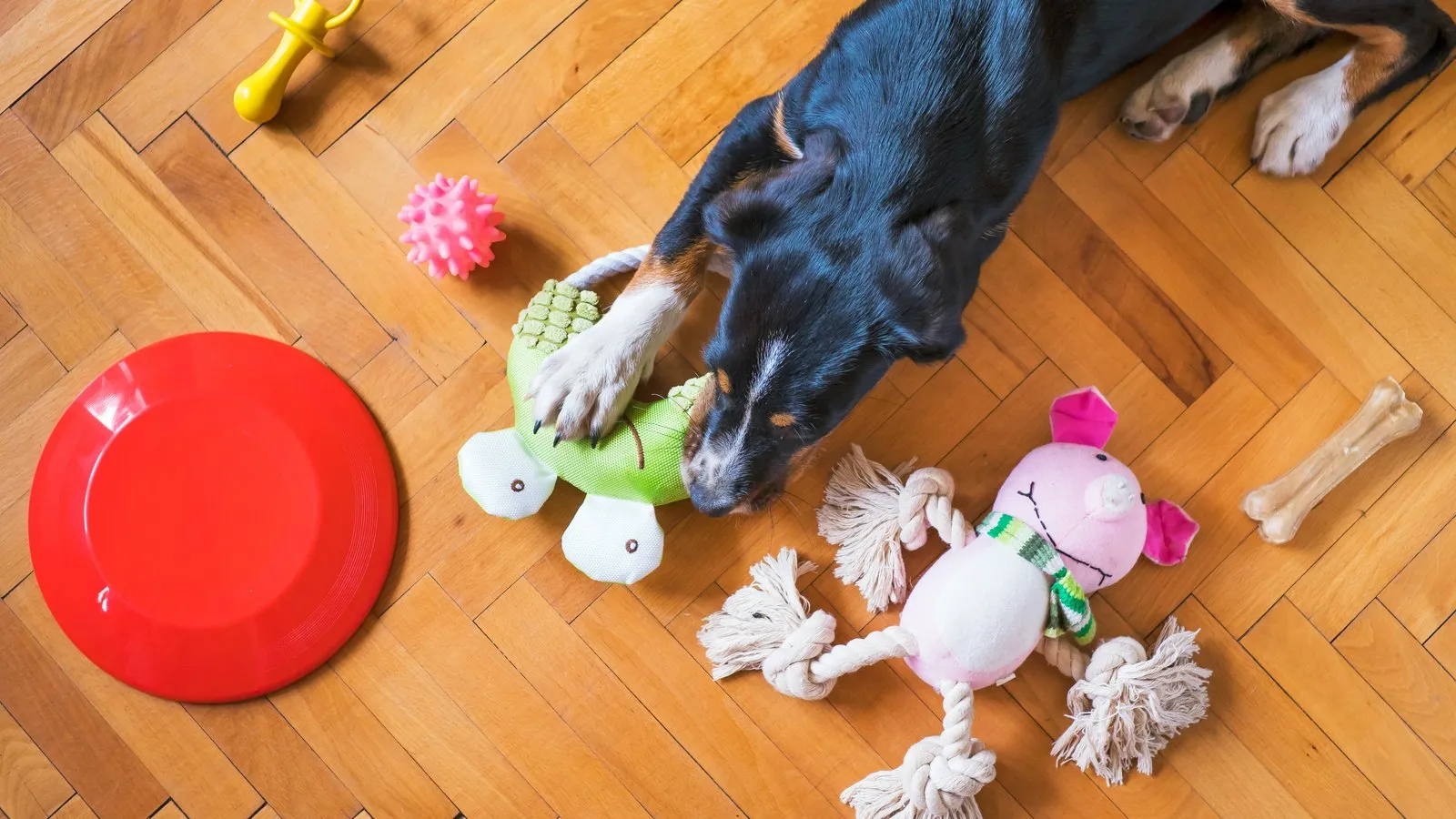
The short answer
- Our pick
- A soft-rubber puppy Kong, stuffed and frozen. Zooplus lists the small at £6.79 and the medium at £9.89 in September 2026. It passes the thumbnail test, the cold does the work on sore gums, and stuffing it turns five minutes of chewing into forty.
- On a budget
- Rotation rather than purchase. Three cheap toys kept in a cupboard and brought out one at a time hold a puppy's attention better than six left on the floor, and the teething window is short enough that you will not be replacing them.
- Don't buy
- Antlers, hooves, bones, nylon chews and tennis balls — every dog, every age. The first four are hard enough to fracture a tooth; the fifth sands the enamel off. If your thumbnail leaves no mark in it, your puppy's tooth takes the mark instead.
On this page
The pet shop aisle is organised around the wrong question. Almost everything on it is sold on how long it will last, because that is what an exhausted owner with a chewed skirting board walks in asking for. Hardness is the selling point, and “indestructible” is the word on the packet.
Hardness is also the thing that fractures teeth. Those two facts sit about a metre apart on the same shelf and nobody joins them up.
The Veterinary Dentistry Specialists put the rule in one sentence: if you cannot make an indentation in the toy with your nail, it is too hard for your dog’s teeth. That is the whole test. It takes two seconds, it works in the shop before you have paid, and it disqualifies most of what is marketed at teething puppies.
How long you are actually buying for
Shorter than the spending suggests. A puppy has a complete set of 28 baby teeth by five to eight weeks, before he comes home. Adult teeth start pushing through at 12 to 16 weeks, premolars follow at 16 to 24 weeks, and the full 42 adult teeth are usually in place somewhere between 20 and 28 weeks.
Blue Cross puts the teething phase itself at three to seven months. So from the day the chewing becomes a problem to the day the last molar arrives, you are looking at roughly four months.
That matters for the budget. Four months is not long enough to justify a forty-pound “lifetime” chew, and the dog you would be buying it for does not exist yet — his jaw, his bite strength and his preferences will all have changed by the time it pays for itself.
What fails the thumbnail test
Antlers, hooves and bones. Rigid enough to fracture a tooth outright. A fracture that opens the pulp cavity is painful, gets infected, and ends in an extraction or a root canal — the single most expensive thing on this page by a distance.
Nylon chews. Marketed as the sensible alternative to bone, and made of hard plastic that is every bit as capable of cracking a carnassial. The packet’s claims do not change what your nail tells you.
Ice cubes. This one catches people out, because it arrives dressed as a free home remedy for sore gums. Run the test: frozen water takes no thumbnail mark at all. A block of ice is as hard as any of the chews above. Cold is genuinely useful for a teething puppy — the ice cube is simply the worst way to deliver it.
Tennis balls deserve their own paragraph
Nearly every British household with a dog has one, and the damage they do is not the kind you notice.
The fuzzy coating is abrasive. It behaves like fine sandpaper, and a dog who carries and chews one wears his enamel down over months and years rather than breaking it in one afternoon. Once the enamel is gone, bacteria reach the dentine underneath, and what follows is sensitivity, infection, and eventually the death of the tooth.
Throwing a tennis ball for a dog to fetch is not the problem. Leaving one where he can sit and chew it is.
None of this is a reason to panic about a ball your dog has had for a year. It is a reason not to make it the thing he gnaws while you watch television.
What passes, and what to do with it
Soft rubber, and not much else. The puppy-specific Kong is made in a softer compound than the adult version — zooplus describes it as “especially soft, tooth-friendly natural rubber” — and it currently lists at £6.79 for the small and £9.99 for the medium.
On its own, a rubber toy is about five minutes of interest. Stuffed, it is a different object. Blue Cross recommends hollow rubber toys filled with biscuits or cheese spread precisely because the food is what holds the attention, and the chewing comes along for the ride.
Stuff it, then freeze it. That is where the cold belongs: in the food, inside something soft, rather than in a block of ice. Wet kibble, a spoon of plain yoghurt, a smear of dog-safe peanut butter — freeze it overnight and a five-minute toy becomes a forty-minute one that also happens to numb a sore gum. Do two or three at a time and keep them in the freezer, because the evening you need one is never the evening you planned for.
Beyond that: a rope toy for tugging, something soft to carry, and a chew sized so that he cannot get the whole thing to the back of his mouth. Blue Cross’s warning about large chews is worth repeating — if your puppy is a swallower rather than a gnawer, anything he can break a lump off is a blockage waiting to happen, and that is an emergency surgery, not a vet visit.
Rotation does what buying more does not
Six toys on the floor is six boring toys. The same six in a cupboard, brought out two at a time and swapped every few days, reads to a puppy as a new toy every few days. Blue Cross makes the same point about rotating chews to keep them novel.
This is the cheapest advice on the site and it is the reason the budget recommendation above is not a product. Most people who feel they need to buy another teething toy actually need to put three of the ones they own out of sight for a week.
The chewing that is not teething
Here is the part that catches owners out at about eight months, when they think they are through it.
Blue Cross notes that adolescence, roughly seven to twelve months, brings its own wave of chewing as the adult teeth settle into the jawbone. The teeth are all in by then. The chewing is not over. If you have been telling yourself it will stop at six months, it is worth knowing in advance that it usually does not, and that the second wave is done by a dog with a full adult bite and considerably more power behind it.
The toys do not change. The supervision does — an adolescent left alone with something he can destroy will destroy it, and swallow some of it.
Check his mouth at six or seven months
Worth doing once, and almost nobody does.
By seven months the baby teeth should all be gone. If a baby canine is still sitting beside the adult canine that has come in next to it, that is a retained deciduous tooth, and it is not something that resolves itself. It traps food, pushes the adult tooth out of line, and usually needs extracting. A thirty-second look while he is relaxed is all it takes, and your vet will check it at the same appointment as anything else.
Who should not buy a teething toy
If your puppy is under twelve weeks and not yet chewing, you do not need one yet. The problem announces itself; buying ahead of it just means buying for a mouth size he will pass through.
If what you actually have is a puppy destroying furniture while you are out of the room, no toy on this page fixes that, and the ones that promise to are the hard ones this article has spent a thousand words warning you off. That is a management problem — a puppy who cannot be supervised needs to be somewhere he cannot do damage, which is what a crate or a pen is for, not a tougher chew.
And if your dog is past teething and you are shopping for something to occupy a determined adult chewer, this is the wrong list. The thumbnail test still applies, but the sizing and the durability question are genuinely different, and buying a puppy Kong for a two-year-old labrador is money thrown away.
What to do next
If the chewing is happening because your puppy is loose in the house with nothing to do, the fix is spatial rather than dental — the puppy crate size guide covers how to work out the size he needs, and why buying for the adult dog is usually right.
And if he is chewing his lead as well as everything else, the leads, collars and harnesses guide explains which of those three things is worth spending on and which is a consumable — the same logic as this page, applied at the other end of the dog.
Prices in this guide were checked in October 2026 at UK retailers and change often, so treat them as a guide rather than a quote. The chew-safety guidance here follows the Veterinary Dentistry Specialists and Blue Cross; the teething timeline follows veterinary-reviewed figures for domestic dogs. Nothing here is veterinary advice — for anything to do with your puppy’s mouth, teeth or a suspected blockage, speak to your vet.