Puppy nail clippers: three types, one real risk, and a claim that just got tested
The short answer
- Our pick
- A scissor or plier-style clipper. Millers Forge is £7.99 at Splendid Pets with a guard and a lock, and it is the type most vets name when asked, because it lets you cut at an angle rather than straight across. It will outlast the puppy.
- On a budget
- A guillotine, at £4.00 for the Wahl or Ancol at VioVet. We went looking for a veterinary source behind the usual 'guillotines crush the nail' line and could not find one — the real objections are about control and keeping it sharp. Held perpendicular on a small or medium nail, it is fine.
- Don't buy
- Human nail clippers and scissors, which PDSA names specifically: they 'aren't designed for dog claws, so are likely to squash them and cause them to split'. And doing it yourself, first time, on a dog whose nails are all black — Blue Cross says to let a vet or nurse show you.
On this page
Nail cutting is the one bit of puppy grooming people genuinely dread, and the advice around it is a strange mix of solid veterinary guidance and things everyone repeats because everyone repeats them.
One of those things got tested this year, and the result is worth leading with.
The gait claim, and what a 2026 study found
The standard argument for keeping nails short goes: long nails push the toes backwards, the dog shifts how it stands, and over time that stresses the joints.
In 2026, researchers published a study in Frontiers in Veterinary Science that actually measured it. They ran seven clinically healthy dogs over a pressure-sensing treadmill, trimmed their nails, and ran them again — 137 gait trials in total.
Nothing moved. Stride length, stance duration, vertical ground reaction forces, weight distribution: no significant change. Forepaw length fell by 2.2mm and the side-to-side movement of the centre of pressure changed by less than one per cent. The authors concluded that longer claws “do not impair overall locomotor function” in sound dogs, and raised the possibility that long nails are a consequence of an abnormal gait rather than a cause.
Hold two things at once here. Seven dogs is a very small study, they were healthy, and their nails were moderately long rather than grossly overgrown — so this is not a licence to stop cutting. But it does mean the confident “long nails change your dog’s gait” line that appears on every pet shop page is, on the one occasion someone measured it, not supported.
What is still well established
The reasons to keep nails short survive the study above intact, because they are about pain and damage rather than biomechanics. The Royal Kennel Club:
- Long claws are “more prone to chipping, tearing, splitting and breaking, which can be very painful” and often need a vet.
- In severe cases “the claws can grow so long that they curl over and dig into the pad.”
- And the one that changes your schedule: “long claws will also have a long quick.”
That last point is the practical heart of it. Leave nails too long and you cannot simply cut them short again, because the blood supply has grown out with them. The RKC says restoring a neglected set “may, in some instances, take months.”
The reverse is widely stated too — that frequent small trims make the quick recede. The AKC’s chief veterinary officer says so, and so does a US veterinary source; we found no UK charity and no published study making the claim. It is clinical consensus rather than evidence, and worth presenting as such.
How often, and a test that does not work
| Source | Guidance |
|---|---|
| Dogs Trust | Check every couple of weeks; if the nails are off the ground, they probably do not need cutting |
| Royal Kennel Club | Trim once or twice a month, depending on activity and surfaces |
| Blue Cross | Natural wear is often enough and trimming “is often not necessary” |
| PDSA | Hard surfaces wear them down naturally; just check routinely |
That is a genuine disagreement between British welfare bodies — once or twice a month against often not at all — and it resolves on pavement. Dogs Trust puts it well: adding hard-ground walking to the routine “can be enough to keep your dog’s nails trim,” and lighter dogs wear them down less.
The clicking test is wrong. You will be told that if you can hear nails on a hard floor, they are too long. Blue Cross says the opposite: dogs with properly-lengthed nails naturally make a clicking sound on solid surfaces, and clicking “does not necessarily mean their nails are too long.”
The test that both Dogs Trust and veterinary sources actually use is ground contact when the dog is standing still. If the nails touch the floor when the paw is weighted and flat, they are long. If they clear it, leave them.
Dew claws are the exception to everything above. They never touch the ground, so they never wear down, and Blue Cross singles them out as the one claw that usually does need attention. Check the inside of each front leg, and check the back legs too — some dogs have them there. A few breeds have doubles on the hind legs as a matter of breed standard: the Royal Kennel Club requires “strongly made double dewclaws on each hindleg” in the Pyrenean Mountain Dog, and calls them “of utmost importance” in the Briard.
The three types
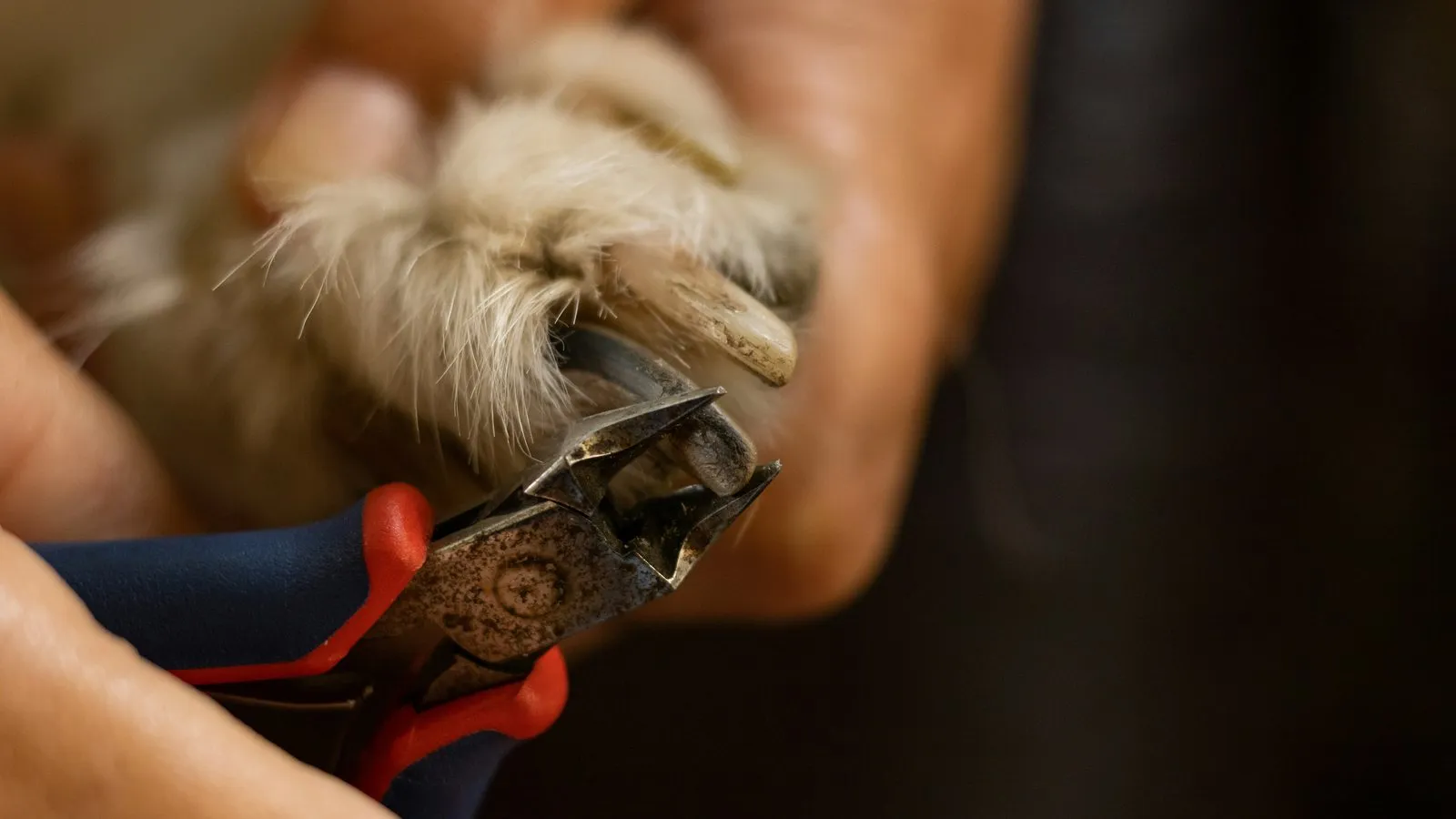
Scissor or plier. Two curved blades passing each other. Lets you cut at an angle, which matters because a dog’s nail is not a flat surface. The type most vets name when asked. Blunts over time and cannot easily be sharpened, so replace rather than persevere.
Guillotine. A hole you put the nail through, and a blade that sweeps across. Cheap, and makes a clean straight cut. We went looking for the source of the ubiquitous claim that guillotines crush rather than cut, and could not find a named veterinary source for it. The real objections are narrower: a vet who dislikes them says the problem is control and the inability to cut at an angle; another says crushing comes from holding them wrongly, and that the fix is to hold them perpendicular to the nail. A blunt blade or an aperture that is the wrong size for the nail will mangle a cut. A sharp, correctly sized one will not.
Grinder. A rotating file. Better on thick nails and genuinely better on black ones, because you take material off gradually and can stop the moment the nail surface changes. Against it: loud, slow, generates heat so you work in short bursts, and long coat can catch in the rotating head. Dogs Trust notes they “may be louder and take longer.”
What not to use is the only thing PDSA is prescriptive about: “Never use scissors or human nail clippers — they aren’t designed for dog claws, so are likely to squash them and cause them to split.”
Finding the quick
The quick is the living core of the nail, carrying the blood vessels and nerves. Cutting it hurts and bleeds freely.
On a pale nail you can see it as a pink core. Blue Cross says to stop a few millimetres short of it.
On a black nail you cannot see it at all, and every UK source converges on the same cautious answer: take off only the very sharp tip. Dogs Trust says exactly that. The Royal Kennel Club adds a useful signal — trim gradually, and stop when a black spot appears in the centre of the cut surface, which means you are approaching the quick. PDSA suggests estimating from a pale nail on the same dog, and if every nail is dark, “ask your vet to show you where to cut.”
The torch trick is real and endorsed. Dogs Trust suggests shining a light through the nail to see the quick more clearly. It works best on thinner, paler nails and is unreliable on thick black ones — but it costs nothing to try.
The cheapest thing in the kit is in your baking cupboard
If you do nick the quick, the commercial answer is styptic powder, which clots the blood. In the UK it runs about £9 to £12 for a 30g pot — Hatchwells Trimmex is £11.05 at VetUK.
Except that when we checked, zooplus, VioVet’s nail section and the PDSA’s own pet store were not stocking styptic powder at all. Which makes PDSA’s advice the practical one, and they give it by name:
“If a nail bleeds, don’t panic — you can dip it in cornflour to help it clot or hold some cotton wool on it until it stops bleeding.”
Cornflour, bicarbonate of soda and plain flour all work the same way: packed into the end of the nail with light, steady pressure. Hold it for a minute or two without squeezing the toe. If it has not stopped after ten minutes, or if a nail has been torn rather than cut, that is a vet call.
Buy the powder if you like — it stings less than a styptic pencil and some contain a mild numbing agent. Do not let its absence stop you starting.
What everything costs
| Item | Price | Where |
|---|---|---|
| Trixie Easy Claw clippers, 8cm | £2.29 | zooplus |
| Wahl or Ancol guillotine | £4.00–£4.90 | VioVet |
| Ancol Ergo scissor clippers | £5.50–£7.00 | VioVet |
| Wahl nail clippers | £7.60 | VioVet |
| Millers Forge plier-style, with guard and lock | £7.99 | Splendid Pets |
| Mikki nail clippers | £7.35–£17.50 | VioVet |
| Wahl battery nail grinder | £12.99 | VioVet |
| Wahl electric nail grinder | £34.88 | VioVet |
| Dremel 7020-PGK pet grooming kit | around £30–£43 | varies |
| Hatchwells Trimmex styptic powder, 30g | £11.05 | VetUK |
And the comparison that actually decides it. A nail trim at a UK vet practice: £24.74 with the surgeon, £16.87 with the nurse at one practice’s published price list. A groomer charges roughly £8 to £15 for a nail trim on its own.
So the entire DIY kit — a Millers Forge and a pot of styptic powder — comes to about £17.50, which is the price of one nurse appointment. At the Royal Kennel Club’s once-or-twice-a-month schedule, paying someone else is £150 to £300 a year, every year, for fifteen years.
Teaching the puppy to allow it
This is the part that decides whether you are doing this calmly for the next decade or wrestling a frightened adult dog twice a year. Start now, before the nails need cutting.
Dogs Trust’s principle: get the puppy comfortable with having their feet handled, and “always pair this with a tasty treat so they learn to think of having their feet handled as a good thing.” PDSA says the same and adds that it should start early.
The useful version is a ladder, and you only move up a rung when the puppy is relaxed at the one below:
- Touch the shoulder, treat.
- Shoulder to elbow, treat.
- Down to the wrist, treat.
- Hold the paw, treat.
- Hold one toe, treat.
- Repeat all of the above while holding the clippers in your other hand.
- Bring the clippers towards the nail an inch at a time, treating each time.
- Tap the nail with the clippers, treat.
- Cut a cocktail stick next to the paw so the puppy hears the sound, treat.
- Take a sliver off one nail. Stop. Treat. Done for the day.
Keep sessions to a minute or two, a few days a week. If you are introducing a grinder, add sessions where you switch it on across the room and treat — the noise is most of the problem.
One nail a day is a perfectly good schedule. Nobody said you have to do sixteen in one sitting.
Who should not do this at home
If every nail is black and you have never done it. Blue Cross: “it’s safer to let a vet or nurse trim their nails.” PDSA says to have the vet show you where to cut. One appointment buys you the knowledge for the next fifteen years.
If the nails are already severely overgrown, ingrowing or splaying. Dogs Trust says contact the vet. The quick has grown out with them and shortening them is a staged job over months.
If the dog is frightened. Trembling, drooling, panting, growling or snapping means stop and go back several rungs on that ladder — or get help. A dog who has been quicked once remembers it, and pushing through creates a problem that outlasts the nails.
If your puppy is a giant breed with very thick nails, a grinder will be easier than any clipper, and it is worth getting used to the noise early rather than discovering the problem at eight months.
What to do next
Nails are one line of a short list, and the puppy grooming kit guide covers the rest — including why the comb matters more than the brush, and what a matted coat actually costs at the groomer.
If you are working through the kit in order, puppy shampoo explains why the pH argument on every bottle is real but smaller than it looks, and which bottle in that aisle is a straight waste of money.
The gait study is Häusler and Söhnel, Frontiers in Veterinary Science 2026, a retrospective analysis of 137 gait trials from seven healthy dogs — a small sample, reported here as the only measurement we could find rather than as a settled finding. Guidance on frequency, the quick, dew claws and bleeding is quoted from Dogs Trust, PDSA, Blue Cross and the Royal Kennel Club, checked October 2026; the quick-recession claim is attributed to the AKC’s chief veterinary officer and is not supported by a UK source or a published study. Breed standards are the Royal Kennel Club’s own. Prices were checked at UK retailers in October 2026 and move often. Nothing here is veterinary advice — for an overgrown, ingrowing or damaged nail, or a dog who is distressed by handling, speak to your vet.