Puppy crate size guide (UK): 24in to 48in, by breed
The short answer
- Our pick
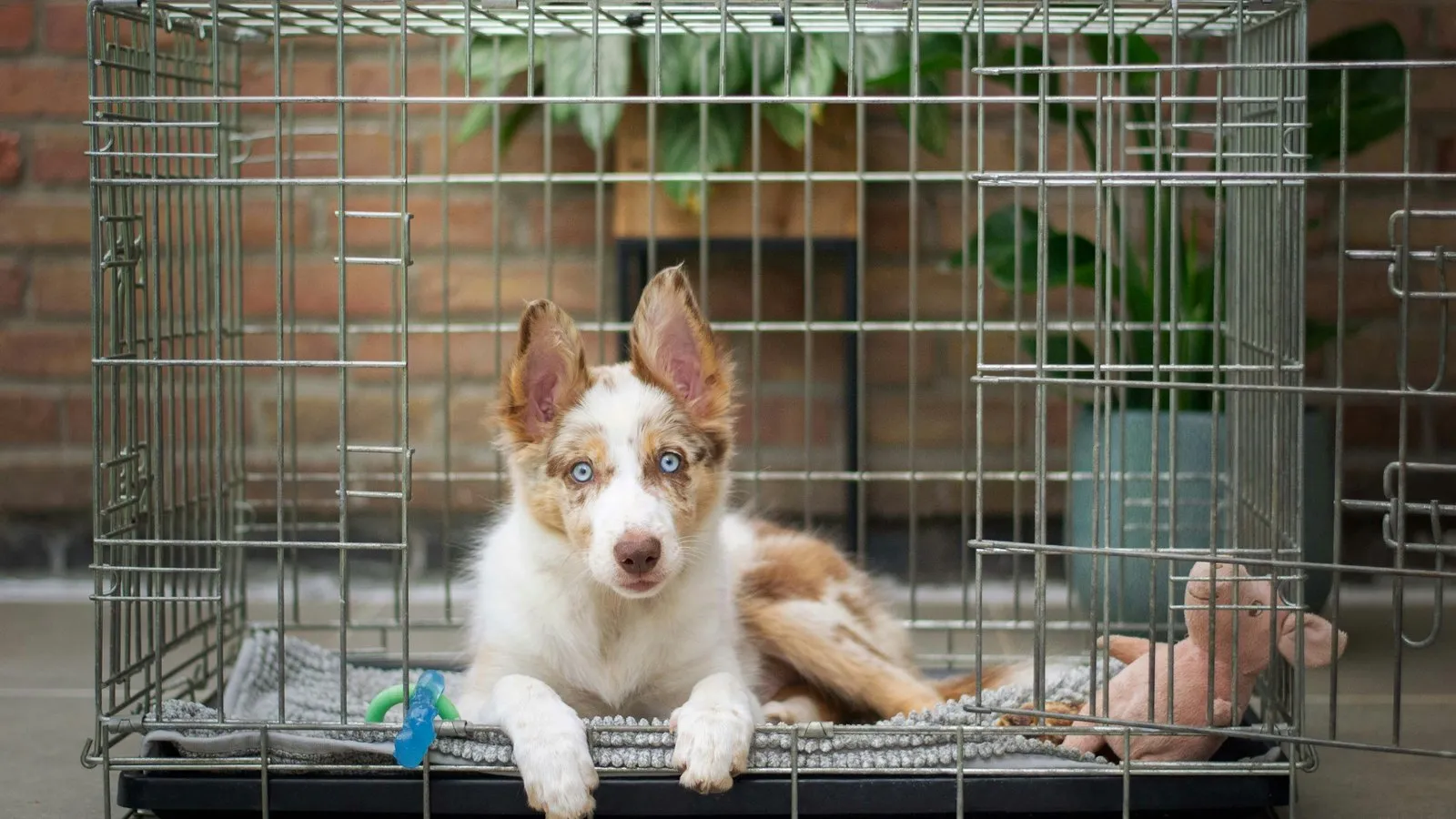
- Buy the crate your dog will need as an adult and use the divider panel to shrink it while they grow. The test is simple: standing without lowering the head, and lying flat on their side with all four legs stretched out without touching the door.
- On a budget
- Any wire crate with a divider and a slide-out plastic tray. Omlet's Fido Classic is £40 at 24in and £50 at 36in; the brand matters far less than the divider.
- Don't buy
- Anyone whose puppy already sleeps settled and toilet-trained in a room, with no car travel planned. And anyone planning to crate a dog through a working day — no size makes that kind. A crate is a tool, not an obligation.
On this page
Before I retired from running a boarding kennel in Rio de Janeiro, the wrong crate size was the kit mistake I saw more often than any other — and I made it myself, with my own Boxer. The rule I ended up enforcing at the kennel is short: a dog must be able to stand without lowering its head, and lie flat on its side with all four legs stretched out without touching the door. Anything less is not a den. It is a box.
This guide gives you the measurement that settles it, the sizes British retailers actually stock, and the two ways people get it wrong.
The rule that actually matters
The RSPCA’s wording is that a crate should be big enough for the dog to stand, turn around, lie down and stretch. The kennel version above is the same rule made testable: watch the dog stand, then watch the dog sleep.
Measure the dog, not the breed:
- Length. Nose to base of tail, standing, then add 5–10 cm.
- Height. Floor to the top of the head while sitting, then add 5–10 cm.
Round up to the next crate size. British crates are sold in inches — 24”, 30”, 36”, 42” and 48” are the common steps — and that figure is the crate’s length.
What the wrong size actually looks like
Hercules was a Dobermann who came to the kennel for a long stay, with the plastic carrier he had used since he was a puppy. His owner swore he loved it as a den. It was too short for the half-circle turn dogs make before lying down, so he lay with his neck bent, and every time he tried to stand he hit his head on the roof. With no room to move away from his own mess, he wet the back of the carrier and ended up lying on wet paws. He spent his first hours crying and scratching at the door.
We moved him straight into one of our giant metal crates. He walked in, turned three full circles, sighed, and was asleep within minutes. The crying stopped, and he never soiled the crate again.
At home I was getting it wrong at the same time. Between eight and ten months, Bóris, my Boxer, shot up — all legs and chest — and his crate had not kept up. He didn’t cry. He spent the nights knocking his elbows against the sides trying to stretch out, which kept him and the whole house awake. I retired the old crate and bought an extra-large wire one, and the first night he lay fully on his side. These days he sleeps on his back with his legs pressed against the bars, snoring loud enough to wake the street.
Two dogs, two lessons. A crate that is too small does not just make a dog uncomfortable: it causes the soiling and the crying that people then blame on the dog. And a puppy can outgrow a crate in weeks, not years.
Buy for the adult dog, and use a divider
This is the part that saves money, and Bóris is the reason it matters. A puppy outgrows a puppy-sized crate in a few months, and large breeds have growth spurts that make the timing hard to predict. Instead, buy the size the adult dog will need and use the divider panel most wire crates include to shrink the usable space, moving it back as the dog grows.
If the crate you are looking at does not come with a divider, that is a reason to look at a different crate rather than a reason to buy two.
Rough sizes by breed
Treat this as a starting point, then measure. Within any breed there is more variation than people expect, and crossbreeds sit wherever they like.
| Adult size | Crate length | Typical breeds |
|---|---|---|
| Small | 24” | Jack Russell, Dachshund, Miniature Poodle, Pug |
| Medium | 30” | Cocker Spaniel, Cockapoo, Beagle, Border Terrier |
| Large | 36” | Border Collie, Springer Spaniel, Whippet, Staffie |
| Extra large | 42” | Labrador, Golden Retriever, Boxer, German Shepherd |
| Giant | 48” | Great Dane, Newfoundland, Bernese, a large Dobermann |
A cockapoo is the one people get wrong most often, because the size depends on whether the poodle parent was miniature or standard. A 30” crate suits most; a large cockapoo will want 36”. The cockapoo crate guide goes through the one question to ask the breeder.
Where the “too big is fine” advice goes wrong
You will read that a bigger crate is always kinder. For an adult dog who is already house-trained, that is broadly true. For a puppy in the first weeks it is the opposite: spare space is precisely what removes the instinct not to soil the sleeping area, and a puppy with a spare room will use one end as a toilet. The divider exists for this reason, and it is why toilet training goes faster in a crate that is snug rather than generous.
The other failure is the one Hercules and Bóris showed: a crate so tight the dog cannot straighten out on their side. A dog who cannot lie flat will not settle, and a dog who will not settle will tell you about it at four in the morning.
Height is the measurement people forget
Length gets the attention because it is the number on the box. But a tall, leggy dog — a lurcher, a young collie, a standard poodle cross, a Boxer mid-growth-spurt — will hit the roof of a crate that is nominally the right length. If the dog has to lower their head to stand, the crate is too short whatever the label says.
Two things eat into height that people do not count. The bed: a thick cushion can lift the dog several centimetres. The listed size: retailers usually quote outside dimensions, and the bars, frame and tray take a few centimetres off the inside. If your dog is close to a size boundary, check the internal measurements or go up.
What the Omlet range covers, and where it stops
The Omlet Fido Classicad is a folding wire crate with a divider and a plastic tray, sold in three sizes: 24in (dogs to 11kg), 30in (to 20kg) and 36in (to 32kg). When we checked in September 2026 the 24in was £40 and the 36in £50. It is also sold for car use, which matters if the crate is going to travel.
The honest limit: the Fido range stops at 36in. For a Labrador, a Boxer, a German Shepherd or anything bigger, Omlet does not make your size, and you need a 42in or 48in crate from someone else. Buying a 36in for an extra-large breed because you like the look is exactly the mistake this page exists to stop.
Before you buy, check three things
The door. Single door, double door, or a sliding door that does not swing into the room. In a narrow British hallway or a small kitchen, a sliding door is often the difference between a crate that fits and one that does not.
The tray. A plastic tray that slides out is worth having and will be cleaned more often than you expect. Metal trays are louder and buckle over time.
The folded size. Most wire crates fold flat. If the crate will travel in the car, or be put away, the folded dimensions matter as much as the open ones.
How long a crate is fair
A crate of the right size is a bedroom. It is not a place to spend the day. The RSPCA puts an adult dog’s limit at around three hours, says puppies need breaks far more often, and states that it is never acceptable to shut a dog in a crate all day while you go to work. Never use it as a punishment, and leave the door open when the dog is not being confined, so it stays somewhere they choose to go.
If you need to contain a puppy for longer than that, the answer is a bigger safe area — a puppy-proofed room behind a stair gate, or a pen with the crate open inside it. Playpen or crate covers why Dogs Trust says it is usually not a choice between the two.
Who should not buy a crate at all
If your puppy is already settled sleeping loose in a room, is toilet-trained, and you have no plans to travel by car with them, you may simply not need one. A crate is a tool for house-training, safe containment and car travel. It is not compulsory, and buying one out of obligation, then leaving it unused in a corner, is the most common way to waste sixty pounds on this list.
And if the plan is to leave the puppy crated for long stretches during a working day, the crate is not the problem to solve. That is a question about cover and company, not about kit.
What to do next
If you are still deciding whether you need a crate at all, playpen or crate covers the three-hour limit, what a pen does that a crate cannot, and the cheaper third option almost nobody mentions.
And if the puppy is arriving soon, the first night covers where the crate should go on night one, and why Dogs Trust says not to shut the door.
Sizing and welfare guidance follows the RSPCA (crates: stand, turn, lie down and stretch; around three hours for an adult dog; never all day) and Dogs Trust, checked October 2026. Breed sizes are a starting point drawn from what UK retailers list for each breed; measure your own dog. Omlet sizes and weight limits are Omlet’s own; prices were checked in September 2026 and move often (in October 2026 Omlet’s page showed the Fido Classic “from £38.95”, with no per-size prices, so the £40 and £50 figures are not re-confirmed). The kennel examples are from my own years running a boarding kennel. Nothing here is veterinary or behavioural advice — for a dog showing real distress when confined, speak to your vet or a qualified behaviourist.