Dog training treats (UK): size, calories and cost per session
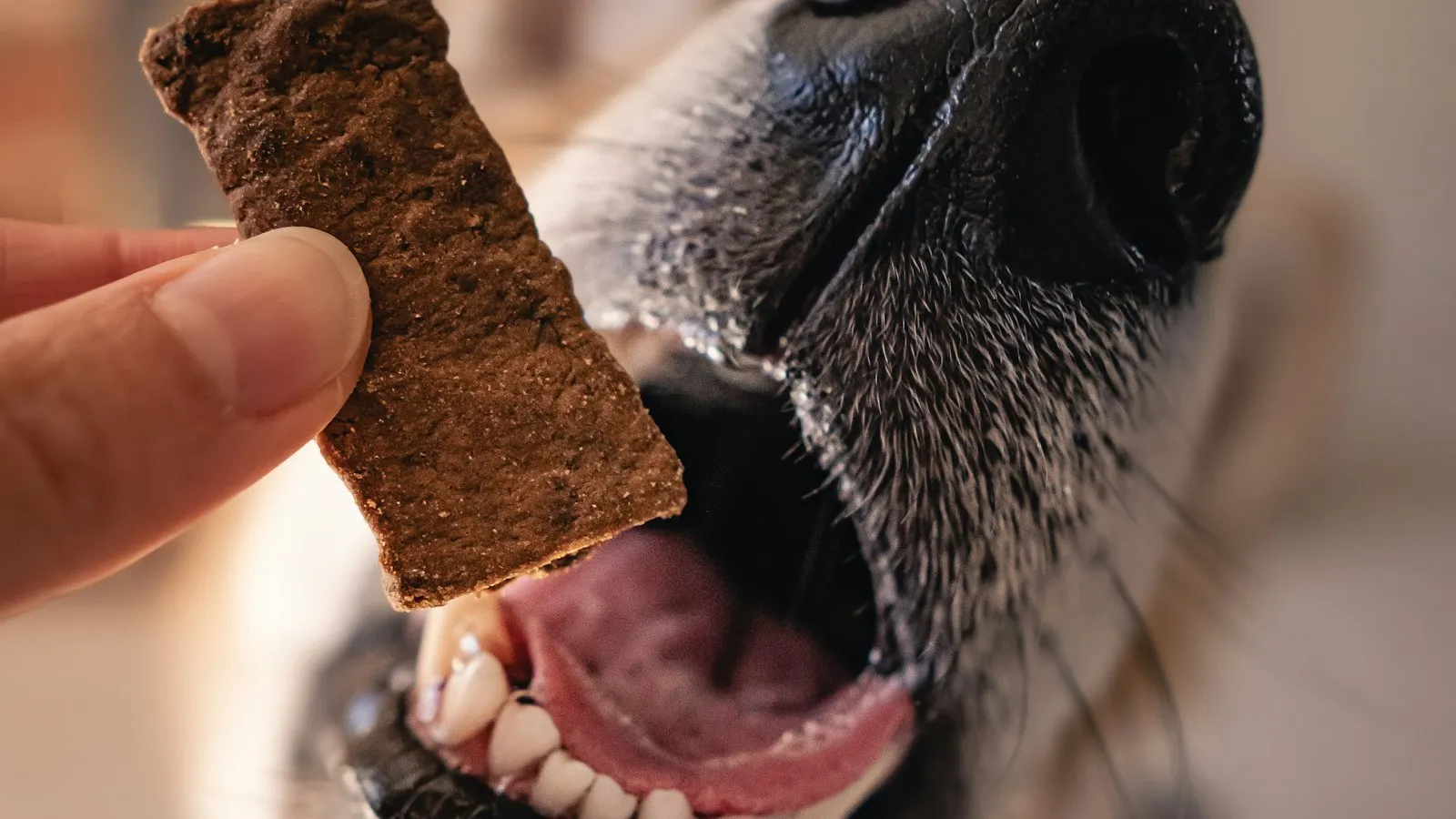
The short answer
- Our pick
- A soft treat that prints its kcal on the pack, chopped to pea size. Skinners Field & Trial Training Treats list 362 kcal per 100g at £2.30 for 90g, which works out at about 70p per 100 kcal. You can plan a session around that number. You cannot plan around a pack that does not give one.
- On a budget
- Your dog's own kibble, taken out of the daily ration. It costs nothing extra, it is already counted in the meal, and PDSA and Dogs Trust both back using smaller or plainer rewards for easy practice. Keep the soft, smelly treats for the hard moments.
- Don't buy
- Buying by flavour and price per kilo while ignoring kcal. Several popular UK training treats do not state energy on the retailer page, so you are guessing the 10% limit. A cheap pack of 2cm pieces can be dearer in calories than an expensive pack of tiny ones.
On this page
The usual advice on training treats is to buy the ones your dog likes best. That is the wrong way round. A dog that will work for anything does not need the best treat. A dog that needs the best treat for every sit is a dog you are overpaying, in money and in calories.
The number that matters is not on the front of the bag. It is the kcal per treat, and a lot of UK training treats do not tell you.
The 10% rule, in plain terms
Dogs Trust: “As a general rule, no more than 10 per cent of your dog’s diet should be made up of treats.” It adds that you should “monitor the number of treats you give your dog and reduce their usual food portions if needed.” Skinners prints the same limit on its own pack: treats “should not count for more than 10% of your dog’s daily food allowance.”
Ten per cent of calories, not of weight and not of the number of pieces. That is where people go wrong. Fifty tiny rewards in a session feels like a lot of food and is usually less than two biscuits.
Here is the arithmetic, using an illustrative dog that eats 1,000 kcal a day (check your own food’s feeding guide; this is a worked example, not a recommendation). The treat budget is 100 kcal. At Skinners’ 362 kcal per 100g, that is about 28g of treats in a day, all training included. Anything you give from your hand, in the garden, on the walk and in class comes out of that 28g.
And if a session goes over, the fix is in the bowl. Dogs Trust again: when food is used in training, “cut down on the amount your dog gets during meals to prevent weight gain.”
What size should a training treat be?
Dogs Trust’s answer is the clearest: soft, smelly treats “can be chopped into small pea-sized pieces for training.” PDSA’s example is “a very small slice of carrot.”
A pea is a few tenths of a gram. A 2cm cube is a different thing. The Chewies Goodies on zooplus are described as “approximately 2cm” and, because they are soft, they can be broken up. Do that. Break each one into four or more and the same pack lasts four times as long and each reward costs a quarter of the calories. The dog does not count. A dog cares that something arrived, quickly, and smelled good.
The treat should also be gone in a second. If your dog has to chew, the session stalls while they do, and the thing you were rewarding has gone cold.
Two kinds of treat, used for different jobs
Dogs Trust splits it neatly. Soft, strong-smelling food, “like cheese, sausage or chicken”, is the “gold star” reward for something hard or something new. Dry biscuits or chopped veg suit easy practice.
That gives you a simple system:
- High value: soft and smelly, used sparingly. New place, new trick, recall past a distraction.
- Low value: kibble, a carrot slice, a plain biscuit. Used for sits in the kitchen.
Most owners use only the top kind, all the time, and then wonder why the dog is bored by the sort they have to use outdoors.
What the packs cost
I looked at what zooplus UK listed as training or soft treats in October 2026. Price per kilo is the figure on the page; the kcal column is what the product page actually states.
| Treat | Pack | Price | Per kg | kcal stated? |
|---|---|---|---|---|
| Skinners Field & Trial Training Treats | 90g | £2.19 | £24.33 | 362 per 100g (Mill Bry Hill; not on the zooplus page) |
| Chewies Goodies (poultry) | 200g | £2.49 | £12.45 | Not on page |
| Chewies Goodies Mini (poultry) | 125g | £1.69 | £13.52 | Not on page |
| Rocco Cubes (chicken) | 150g | £2.29 | £15.27 | Not on page |
| Dokas Chews (duck breast) | 200g | £3.89 | £19.45 | Not on page |
| Rosie’s Farm Mini Steak Bites (chicken) | 70g | £1.69 | £24.14 | Not on page |
| Pet Munchies Chicken & Cheese | 100g | £3.49 | £34.90 | Not on page |
The Skinners kcal figure comes from the Mill Bry Hill listing, not zooplus, where the 90g pack was £2.30; zooplus listed it at £2.19 when I rechecked in October 2026. I have used the Mill Bry Hill price in the sums below because it is the one pack I could check against a stated kcal figure.
Two things stand out. First, only one of these gave me a kcal figure at all. The others may print it on the back of the pack, but the retailer page, where you decide, does not say. Second, price per kilo tells you almost nothing without it. A treat at £12 a kilo that is 300 kcal per 100g costs the same per calorie as a treat at £25 a kilo and 600 kcal per 100g, and the second one is half as many mouthfuls.
For Skinners, I can do the sum. A 90g pack holds about 326 kcal and costs £2.30, so 100 kcal costs about 70p. If your dog’s budget is 100 kcal a day, a pack covers three days and a bit. That is the real cost of a treat: a few pence a session, as long as you keep to the pea.
There is one more variable. The Naturediet Feel Good Soft Baked Training Treats listing on zooplus advertises “4 calories per snack”, suitable from two months, grain-free. It was sold out when I checked, and the mixed pack of eight 100g bags was £26.19. A stated calorie count per treat is exactly the figure you want, even where the price per kilo is not the lowest.
Who should skip bought treats altogether
Almost any dog who will work for kibble.
If your dog eats the daily ration from a bowl in thirty seconds, they are food-motivated enough. Take a handful of the day’s food out before breakfast, put it in a pocket or pouch, and use it as rewards. PDSA suggests exactly that kind of smaller main meal on training days, and it is the only approach where the 10% rule looks after itself, because the treats were never extra.
You will also not need a bag of treats for:
- Toy-driven dogs. PDSA notes that “some dogs like food treats, others prefer praise or a favourite toy.”
- Dogs on a vet-supervised weight plan. Ask the vet what the budget is. Nothing here is a substitute.
- Dogs with a restricted diet. A treat that is not their food is a risk. Use their food.
Dogs Trust’s reward schedule helps the budget too. Reward every correct response while the dog is learning, then every other time, then every third time, mixing in praise or a fuss so the dog cannot predict it. A well-trained sit should not cost a treat each.
If you have a puppy
Puppies burn through treats faster, because everything is new and every session is a lot of repetitions. They also eat less in total, so 10% is a smaller number. How much to feed a puppy explains why the chart on the bag is a starting point, and the training treats come out of that number. If you are buying for the first few weeks, the puppy checklist says what can wait. A packet of expensive treats is on that list.
Teething puppies also tend to want to chew everything, including your fingers. That is a chew problem rather than a treat problem. The teething toys guide covers it.
For older dogs, the same arithmetic applies and the budget often shrinks, because a slower dog burns fewer calories. Tiny soft pieces suit dogs with worn teeth better than hard biscuits.
What it actually costs per month
Take the Skinners price as the benchmark for a premium soft treat: about 70p per 100 kcal. A dog on a 100 kcal daily treat budget would cost around £21 a month if every calorie of the budget was spent on that product. Most dogs get less than the full budget, and kibble rewards cost nothing extra.
For the whole picture of feeding costs, see what it costs to feed a dog per week. Treats are a small line in it, and the bag of expensive ones is where people overspend, usually because the dog never needed them.
What to do next
Work out your dog’s 10% in kcal from the feeding guide on their food, then look at the treat you already own and see what a piece weighs. If the pack does not tell you the kcal, treat that as a reason to switch to a pack that does or to kibble.
Then read how much to feed a puppy if yours is under a year, or the dog food cost guide if you want to see where treats sit in the weekly bill.
The 10% limit and the advice to cut meals, chop treats to pea size and reduce reward frequency come from Dogs Trust (diet and nutrition, and positive reinforcement pages) and PDSA (reward-based training), checked October 2026; Skinners’ kcal and 10% wording is from its pack listing at Mill Bry Hill. Prices and pack sizes are from zooplus UK listings in October 2026 and move often. The 1,000 kcal dog and the monthly cost are illustrative arithmetic, not feeding advice. Nothing here is veterinary advice — for a dog who is overweight, on a restricted diet or has a health condition, ask your vet for a calorie budget.